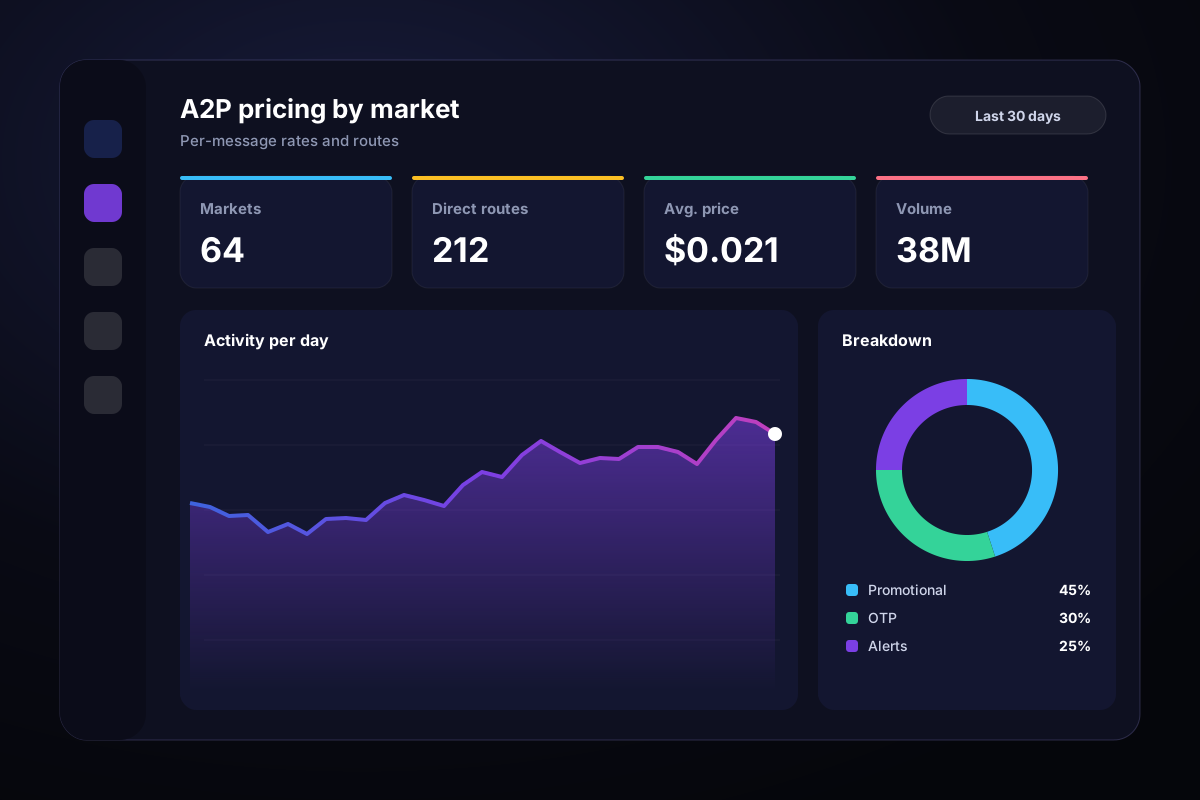

Ask five different SMS providers what a message costs and you'll likely get five different answers — not because anyone's being evasive, but because A2P SMS pricing genuinely depends on a set of factors that aren't always obvious from the outside.
What Actually Drives the Cost Per Message
- Destination country — by far the biggest factor. Rates vary enormously between countries based on local carrier interconnect fees, regulatory fees, and market competition; a message to one country can cost several times more than the same message to another;
- Message type — OTP and transactional messages are sometimes priced differently from promotional/marketing traffic, since carriers and regulators treat them differently;
- Volume — higher committed volumes typically unlock lower per-message rates, similar to any wholesale pricing structure;
- Route quality — direct carrier connections generally cost more than aggregated routes, but deliver more reliably and with better sender ID integrity; and
- Message length — a message over 160 characters (or 70 for messages using certain character sets) splits into multiple segments, each billed separately.
Why Destination Country Matters So Much
Every SMS crossing into another operator's network involves an interconnect fee that operator charges to terminate the message — and those fees are set independently by each carrier in each country, based on their own commercial and regulatory environment. This is why a bulk SMS platform's pricing is typically shown per-country rather than as one flat global rate: the underlying cost structure genuinely differs that much from market to market.
Grey Routes: Why Cheap Isn't Always Better
Unusually low pricing in SMS is often a sign of a "grey route" — traffic routed through channels that bypass proper commercial agreements with the terminating carrier. Grey routes can look attractive on price but come with real risk: unreliable delivery, messages that get silently blocked once carriers detect the pattern, and sender ID that shows as a random number instead of your brand name. For anything business-critical, route quality is usually worth more than the last fraction of a cent per message.
How to Actually Compare Providers
Rather than comparing a single headline rate, look at per-country pricing for the specific markets you actually send to, ask directly whether routes are direct-to-carrier or aggregated, and check what happens to pricing and delivery quality at the volume you actually expect to send — not just the introductory tier.
Message Segments: The Hidden Multiplier
Providers usually bill per message segment, and a text is shorter than most people assume. A single SMS holds 160 characters in the standard GSM-7 alphabet, but only 70 if it contains characters outside it, such as many non-Latin scripts or emoji. Longer messages are split into linked segments of 153 (GSM-7) or 67 characters, and each segment is billed.
So one emoji can turn a 150-character message into a message that costs more than one segment, and a campaign in a non-Latin script can cost noticeably more than the same text in Latin characters. Some markets also add registration or carrier fees on top of the per-message price, so ask for the full cost, not just the headline rate.
Our view: price per delivered message is the only number worth comparing
Two providers can quote very different prices for the same destination and both be telling the truth, because they send over different routes. We’d be wary of any comparison that stops at the price per message.
Ask for delivery reporting by country, ask how routes are sourced, and run a small test to your own numbers before committing volume. A route that costs a little more and actually arrives is usually the cheaper one.
Getting Started
Cyberscape provides transparent, per-country A2P SMS pricing for every market we serve, with direct carrier relationships built for reliability at scale. See current rates on our Services page, or explore pricing for a specific country through our country pages.