
Behind most bulk SMS, OTP and alert traffic there is a quiet workhorse: SMPP. If you send messages through an API, SMPP may be what your provider uses on the next hop. If you run a network, it is how enterprise customers, aggregators and your own platforms talk to the SMSC.
What SMPP is
SMPP stands for Short Message Peer-to-Peer. It is an application-layer protocol that runs over TCP. Instead of sending one HTTP request per message, the sender opens a long-lived connection (a session) to the message center and pushes many messages down it. The sending side is called an ESME (External Short Messaging Entity); the receiving side is an SMSC or a gateway in front of one. For background on the message center itself, see What Is an SMSC?
The protocol was published in versions 3.3 (1997), 3.4 (1999) and 5.0 (2003). Version 3.4 is the one almost everyone runs; it added the transceiver bind and a set of optional parameters.
How an SMPP session works
- Connect. The ESME opens a TCP connection to the provider’s host and port.
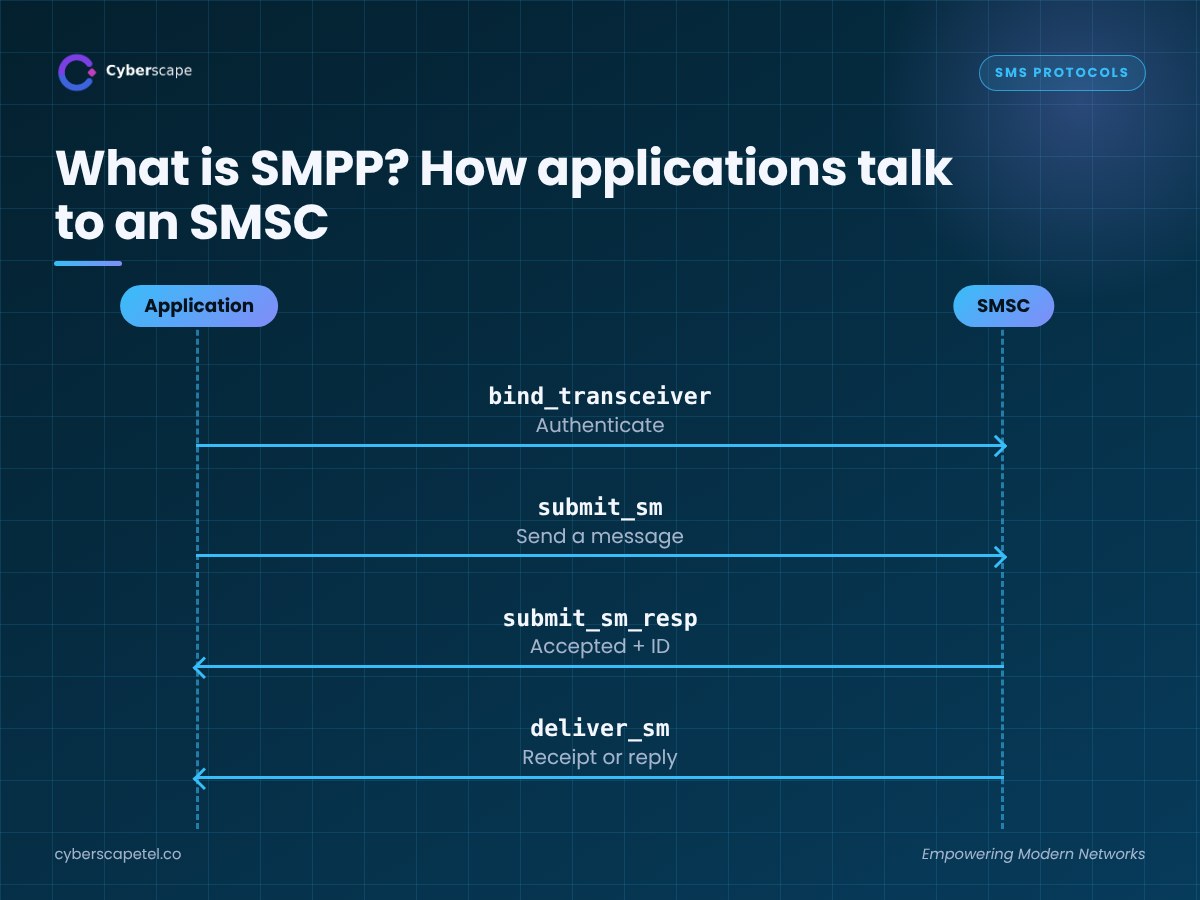
- Bind. It sends one of three requests, authenticating with a system ID and password:
bind_transmitter(send only),bind_receiver(receive only) orbind_transceiver(both on one connection). - Submit. Each message goes in a
submit_smrequest. The SMSC answers withsubmit_sm_resp, which carries a message ID. - Receive. Delivery receipts and mobile-originated messages arrive as
deliver_sm, which the ESME acknowledges withdeliver_sm_resp. - Stay alive.
enquire_linkrequests keep an idle session open and detect dead ones.unbindcloses it cleanly.
Every request carries a sequence_number and the reply echoes it. That is what lets a sender have many requests in flight at once, a “window”, instead of waiting for each reply. The window size and the sustained messages-per-second limit are set by the provider, so ask for both.
A response is not a delivery
The most common misunderstanding: submit_sm_resp means the SMSC accepted the message for processing. It does not mean the handset received it. Delivery status arrives later in a deliver_sm receipt, and only if you asked for one with the registered_delivery parameter. The final states defined in the specification are DELIVERED, EXPIRED, DELETED, UNDELIVERABLE, ACCEPTED, UNKNOWN and REJECTED. We cover how to read them in why SMS messages are not delivered.
Encoding and long messages
- The
data_codingfield tells the SMSC how to read the text. In practice 0 is the default alphabet and 8 is UCS-2, which is what Arabic, Cyrillic and emoji need. - A single
short_messagecarries at most 254 bytes. Longer texts are sent either as concatenated parts, with a User Data Header (flagged inesm_class) or thesar_*parameters, or in themessage_payloadparameter. Your provider will say which it accepts. - Getting encoding wrong is the usual cause of garbled text. See Arabic SMS and the Unicode character limit.
SMPP or an HTTP API?
| SMPP | HTTP/REST API | |
|---|---|---|
| Connection | Persistent TCP session | Request per message or batch |
| Throughput | Very high with a window of in-flight requests | High, scaled with parallel requests |
| Delivery receipts | Pushed on the same session | Webhook callbacks or polling |
| Effort to integrate | Needs an SMPP client library and session handling | Any language, any HTTP client |
| Typical users | Aggregators, operators, high-volume senders | Applications and product teams |
If you are comparing the two, our guide to what an SMS API is covers the HTTP side.
What to agree before you connect
| Item | Ask |
|---|---|
| Endpoint and security | Host, port, and whether TLS or a VPN/IP allowlist is available. The protocol itself does not require encryption. |
| Binds | How many simultaneous binds are allowed, and which types. |
| Window and rate | Maximum in-flight requests and sustained messages per second. |
| Throttling | What the provider returns when you exceed the rate (typically ESME_RTHROTTLED, 0x00000058) and the back-off it expects. |
| Receipts | Format of the receipt text, and the time limit before a message is EXPIRED. |
| Encoding | Accepted data_coding values and how long messages should be sent. |
| Sender ID | How the source address is set and which sender IDs are pre-registered. |
Running an SMPP client well
- Reconnect with back-off. If a bind drops, retry with a growing delay instead of hammering the server.
- Send
enquire_linkon a timer and treat a missed reply as a dead session. - Respect the window. Never exceed the number of in-flight requests you agreed.
- Match receipts to messages using the message ID from
submit_sm_resp, and store it. - Alert on session health, not just on traffic: bind status, window usage, queue age and receipt lag.
Our view: monitor the session, not just the messages
SMPP failures are often silent. A session that has quietly stopped receiving receipts, or a window that is full, looks like “SMS is slow” to the business long before it looks like an outage to the engineers.
We would treat bind state, window utilisation and receipt lag as first-class metrics with alerts, and we would write the agreed limits down in the contract rather than discover them under load. For a new application, an HTTP API is usually the faster start; SMPP earns its place when volume, latency or receipt fidelity justify running a client properly.
Frequently asked questions
What does SMPP stand for?
Short Message Peer-to-Peer. It is a protocol for exchanging SMS between an external application and an SMS center (SMSC) or gateway.
Which SMPP version should I use?
Version 3.4 is the most widely supported and is what most providers and operators expect. Version 5.0 was published in 2003 but is far less common, so confirm what your provider supports before choosing.
Is SMPP secure?
The protocol authenticates with a system ID and password but does not itself encrypt traffic. Use TLS if your provider offers it, or a private link or IP allowlist, and keep credentials out of source code.
What is the difference between submit_sm_resp and a delivery receipt?
submit_sm_resp confirms the SMSC accepted your message and gives it an ID. A delivery receipt, sent later as deliver_sm, reports what happened next, such as delivered, expired or undeliverable.
Is SMPP faster than an HTTP API?
It can be, because one persistent session carries many requests in flight with little per-message overhead. For many applications an HTTP API is fast enough and simpler to build.
Sources and further reading
- SMPP v3.4 specification, Issue 1.2 (PDF)
- SMPP.org: specification versions 3.3, 3.4 and 5.0
- Bird: What is SMPP?
Getting Started
Cyberscape’s SMSC and messaging infrastructure supports operator-grade SMS connectivity, and our messaging services reach more than 800 mobile networks. To discuss an SMPP connection or an SMSC deployment, contact us.
Published November 26, 2026 by Cyberscape Telecommunications FZCO, Dubai. This article is general information, not legal or regulatory advice; rules and platform policies change, so confirm current requirements with the regulator, operator or platform concerned.