
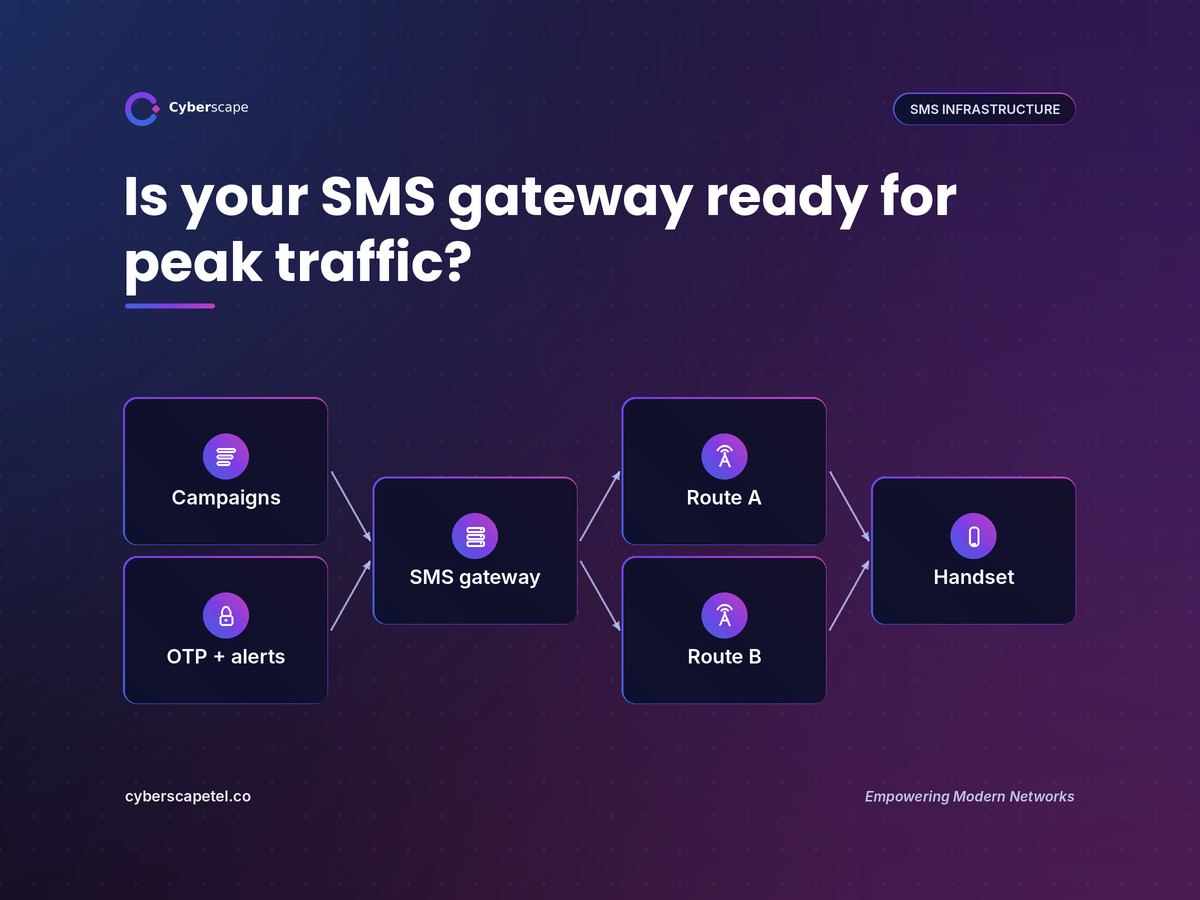

Black Friday, White Friday, a flash sale, a ticket release: every business has a day when message volume jumps and customers are least patient. The messages that fail first are usually the ones that matter most, such as the login code or the payment confirmation stuck behind a promotional blast.
This guide is a readiness plan for the team that owns the SMS gateway, whether that gateway is your own platform or a provider’s. It focuses on what you can control before the day. For a refresher on the building blocks, see What Is an SMS Gateway?
Start with the arithmetic: messages per second, not messages per campaign
Capacity is a rate, not a total. A campaign of 500,000 messages sounds the same whether it goes out over a day or over half an hour, but the gateway sees a very different load. Divide the volume by the time window you actually want:
| Volume | Send window | Rate needed |
|---|---|---|
| 500,000 messages | 30 minutes | about 278 per second |
| 500,000 messages | 2 hours | about 69 per second |
| 500,000 messages | 6 hours | about 23 per second |
Then correct for segments. A message that needs two segments (a long text, or one that contains Arabic or an emoji and so switches to Unicode encoding) counts as two submissions to the network. A 500,000-recipient send of two-segment messages is a 1,000,000-message load.
Separate the lanes: OTP and transactional first, promotional last
The most useful design decision is to stop different traffic types from sharing one queue. Customers tolerate a late promotion. They do not tolerate a login code that arrives after it has expired.
- Priority lane — OTP, payment confirmations and order alerts. Small volume, strict latency, highest priority, ideally on its own connection or route.
- Bulk lane — promotions and reminders. Large volume, delay-tolerant, rate-limited by design.
- Rule — the bulk lane may never borrow capacity from the priority lane. If the system is saturated, promotions wait.
If your provider offers a single shared connection, ask how priorities are handled on it. Our guide to OTP SMS covers why verification traffic deserves special treatment.
Know every limit between you and the handset
A message passes several rate limits: your application, your gateway account, the route to the operator, and the operator’s own platform. The lowest one decides your real throughput. When a limit is exceeded, a network typically answers with a throttling error rather than accepting the message; in the SMPP protocol this is the status ESME_RTHROTTLED (0x00000058). Your sender has to slow down and retry with a back-off instead of resubmitting in a tight loop, which only adds load. See our explainer on what SMPP is for how these connections behave.
Ask your provider, in writing, for the sustained messages-per-second limit per route and per destination country, and whether it can be raised temporarily for the event.
Schedule promotions around the peak, not into it
- Stagger the send. Split a large audience into batches released over hours.
- Keep inside local hours. Many markets restrict promotional messaging to daytime windows; in the UAE, for example, providers commonly cite 7 am to 9 pm for marketing messages. Check the rule for each country you send to.
- Do not stack campaigns. Two teams scheduling “their” Black Friday message for 9:00 will create the spike themselves. Keep one shared send calendar.
Build a fallback before you need one
A single route is a single point of failure. For OTP in particular, line up a second route to the same destinations and agree in advance when traffic switches over (for example, when delivery rate or delivery time crosses a threshold). Decide the secondary channel for the worst case too: a verification code by email, WhatsApp or a voice call can keep the customer moving while SMS recovers. We cover that pattern in SMS fallback and message waterfalls.
Test before the day, with the real flow
- Baseline. Record today’s delivery rate and median delivery time per country and operator, so you know what “normal” looks like.
- Load test the sender. Push a representative volume at the target rate through a test route and watch queue depth, errors and latency.
- Test on real phones. Receive an OTP on handsets from your main operators while the load test runs.
- Rehearse the switch. Practise failing over to the second route, and back.
Watch the right numbers during the event
Submission success only tells you the gateway accepted the message. Track these live, split by traffic lane and by operator:
- delivery rate from delivery receipts;
- time from submission to delivery, especially for OTP;
- queue depth and age of the oldest queued message;
- throttling and rejection errors; and
- OTP conversion (codes requested against codes entered), because a sudden drop is often the first sign of delay.
A delivery receipt is not always proof the handset received the message, so pair receipts with conversion data. We explain this in why SMS messages are not delivered.
A one-page checklist
| Area | Check | Owner |
|---|---|---|
| Capacity | Messages per second needed, including segments, versus limits per route | Platform |
| Lanes | OTP and transactional isolated from promotional traffic | Platform |
| Routes | Second route live and tested for key countries | Provider |
| Schedule | One shared calendar; promotions staggered and inside local hours | Marketing |
| Monitoring | Live dashboard and alert thresholds agreed | Operations |
| Fallback | Trigger and secondary channel for OTP agreed | Product |
| Review | Post-event report: delivery time, failures, what to change | All |
Our view: protect the login code before you optimise the campaign
Most peak-day plans start with the marketing send. We would start at the other end: list the messages a customer cannot proceed without, and design the system so nothing can delay them.
That means a hard separation between verification traffic and promotional traffic, a clearly agreed point at which promotions pause, and a second route that has already carried real messages. A campaign that goes out an hour late costs little. A login code that arrives after it expires costs a sale and a support ticket.
Frequently asked questions
How many SMS per second can a gateway handle?
It depends on the platform and, more importantly, on the limits of the routes behind it. Each route to an operator has its own sustained throughput limit, so ask your provider for the per-route and per-country figures rather than a single headline number.
Why do OTP messages arrive late on busy days?
Usually because the OTP is queued behind other traffic, a route is throttling, or an operator’s platform is congested. Separate lanes for OTP, a second route and live delivery-time monitoring address all three.
When should promotional SMS be sent on a peak day?
Stagger the send across the day, keep it inside the permitted local hours for each country, and keep it behind verification and transaction traffic in priority. Avoid sending every campaign at the same minute.
Do I need to tell my SMS provider before a big campaign?
Yes. Share expected volumes, countries and timing in advance so the provider can confirm route capacity and, where possible, raise limits for the event.
Sources and further reading
Getting Started
Cyberscape provides OTP SMS, alert and transactional SMS and promotional SMS through direct mobile network connections, with 24/7 support. To plan capacity for your next peak, contact us.
Published November 23, 2026 by Cyberscape Telecommunications FZCO, Dubai. This article is general information, not legal or regulatory advice; rules and platform policies change, so confirm current requirements with the regulator, operator or platform concerned.