
Ask an operator's security team what protects the network, and Signaling Firewall and Anti-Spam usually come up in the same breath — often talked about together so consistently that it's easy to lose sight of the fact that they defend completely different layers of the network.
Two Different Attack Surfaces
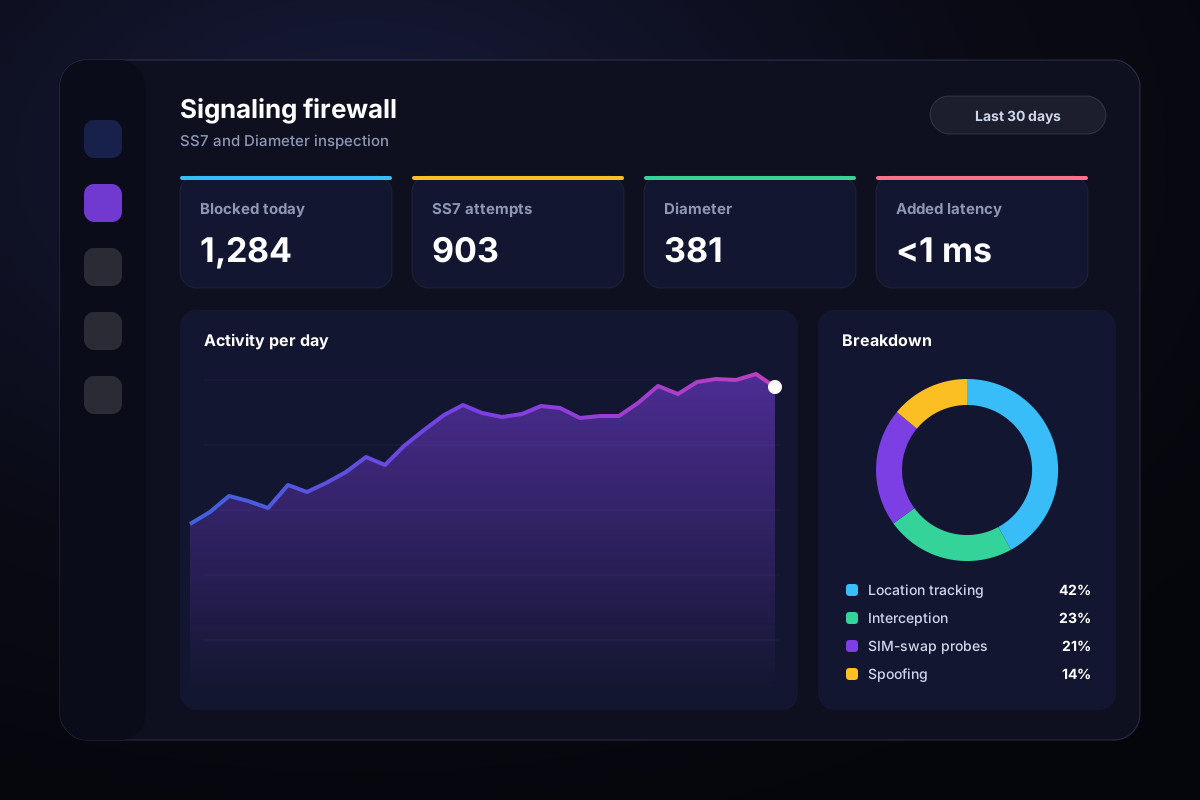
A Signaling Firewall protects the network's signaling layer — the SS7 and Diameter protocols operators use to communicate with each other, locate subscribers, and route calls and texts. Anti-Spam protects the messaging content layer — what's actually being sent through the SMSC to subscribers. One secures how networks talk to each other; the other secures what messages say. See What Is a Signaling Firewall? and What Is Anti-Spam Filtering? for the full detail on each.
Why Operators Need Both, Not Either
- A Signaling Firewall without Anti-Spam leaves the network protected from interconnect-level manipulation but still exposed to bulk spam and smishing riding through as ordinary-looking message content;
- Anti-Spam without a Signaling Firewall filters message content effectively but leaves the underlying signaling protocols — and the subscriber location and interception risks that come with SS7 and Diameter vulnerabilities — completely unprotected; and
- Together, they cover the two attack surfaces that matter most for a modern mobile network: the protocols that connect networks, and the content that flows through them.
How They Complement Each Other in Practice
A sophisticated attack often doesn't stay in one layer. Signaling-level reconnaissance (probing for subscriber location or network vulnerabilities) can precede a content-level fraud attempt, like a spoofed sender ID used for smishing once an attacker has gathered enough information about a target network. Running both defenses together closes the gap that would exist if either layer were left unmonitored, rather than treating network security as a single, undifferentiated problem.
What This Means for Network Security Planning
Operators evaluating network security shouldn't treat Signaling Firewall and Anti-Spam as interchangeable or redundant — they're complementary, addressing different parts of the same overall threat surface. A security assessment that only covers one layer is, by definition, incomplete.
Layered Defence: What Each Layer Sees and Misses
- Signaling firewall — sees the control messages between networks, and can block queries and routing requests that real subscribers or partners would never send; it doesn’t read the text of a message;
- SMS anti-spam — sees the message itself, its sender, volume and patterns, and blocks spam, phishing and grey-route traffic; it can’t see a signaling attack that never carries content;
- The overlap — spoofed originators and fake-routed messages can be caught at either layer, so each backs up the other; and
- Shared intelligence — patterns found at one layer, such as an abusive sender or a suspicious source network, can improve rules at the other.
Our view: buy for the layers, not for the product name
Operators sometimes treat “SMS firewall” as one purchase that covers everything. We’d ask a different question: which layers can this product see, and which can it not?
Mapping the signaling layer and the content layer separately shows the gaps, and it is also the easiest way to avoid paying twice for the same protection.
Getting Started
Cyberscape provides both Signaling Firewall and Anti-Spam filtering as part of our System Integration & VAS services, designed to work together as a coherent security layer rather than separate bolt-on products. See the full lineup on our System Integration & VAS Solutions page.